




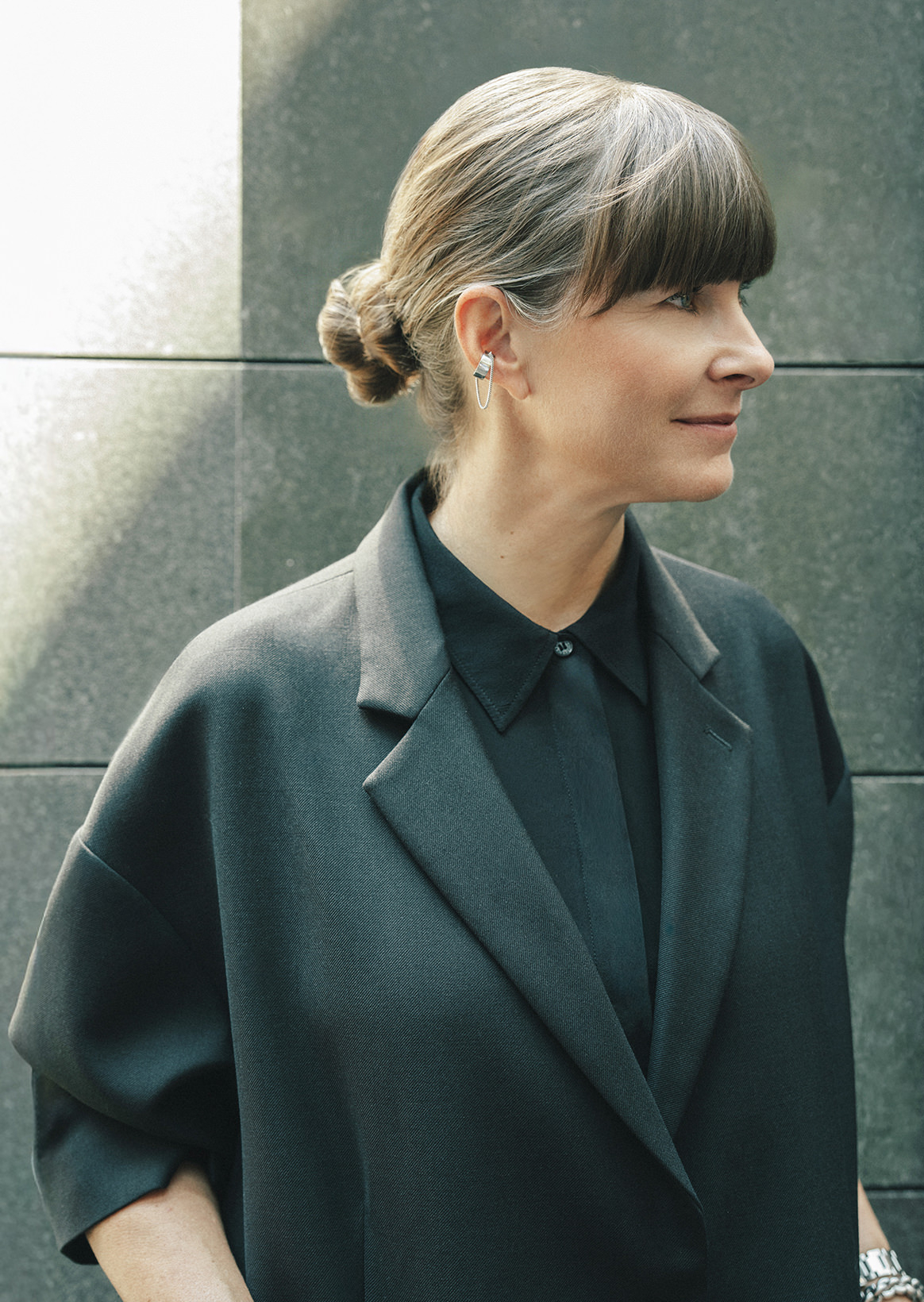
Founded in 2013 in Oslo, Norway by Mona Jansen and Morten Isaksen, Tom Wood is a jewelry brand that reinterprets the signet ring, creating understated yet timeless pieces that possess both a universal appeal unaffected by trends and a strength that enhances the wearer's own features. From its inception, the brand has centered its philosophy on "making things that last," and in recent years has expanded this philosophy into more concrete practice through enhanced transparency and traceability in material sourcing. On June 12th (Friday), the brand's first directly managed store in Osaka opened at Shinsaibashi PARCO. The accompanying exhibition, "A Journey in Craft," focused not only on the finished jewelry but also on the material research and the craftsmanship behind it. We spoke with co-founder Mona Jansen, who visited Japan, about the origins of her creativity, her resonance with Japanese craftsmanship, and the meaning of craftsmanship that deepens with time.
*The English version is available below.
- Photo
- Natsumi Ito
- Text
- Tomoko Ogawa
- Edit
- RIDE Inc.
—You often mention the influence of nature and architecture. Looking back, in what kind of environment do you think your originality and creativity were nurtured?
I grew up on a very small island on the west coast of Norway, surrounded by the sea, forests, and rocky mountains. Our house was a former bakery about 200 years old, and the walls were very thin, so I would fall asleep to the sound of the sea and wake up to the sound of the sea. As soon as I stepped outside, I could smell the sea. There were no telephones or the internet, so as a child I always played outside, made a small garden for animals, and created things with things I found in nature. I think that having nature always close by shaped my perspective on form, texture, and materials, and led to my appreciation for simplicity.
After leaving the island and experiencing the wider world, I became drawn to architecture. I quickly became fascinated by how small details, proportions, and structures shape our perception of things. My parents were teachers, but my mother often took me to exhibitions, plays, and performances, so I grew up in a very creative home. Rather than one environment, I think it was the combination of these various influences and my constant interest in observing and learning that nurtured my creativity. Even now, I find inspiration in the dialogue between nature and human creations—things shaped by culture, history, and craftsmanship.
—After studying economics and building a career in brand strategy, you founded Tom Wood. What was the moment that pushed you to take that first step?
Rather than one decisive moment, it was more of a gradual development of that feeling over time. Initially, it was closer to curiosity, almost like a hobby. I've spent over 15 years in the world of branding and marketing, six of which I ran my own agency, helping others build their brands. While I was often deeply involved in the creative aspects, I was more on the advisory and strategizing side, not actually bringing things to life myself.
A major turning point came when I saw the first prototype I had designed at one of the factories I still work with today. It was a series of signet rings. The moment I saw it, I immediately felt a sense of ownership, like when you see your own child. For me, taking responsibility for something that came from my own creativity was a new experience. This is because creating something yourself is a much deeper, much more personal act than advising others. After about a year of preparation, I left the agency in 2013 and decided to dedicate myself fully to Tom Wood.
— What words or pieces of advice from your journey so far have stayed with you and continue to resonate with you?
Maintain your curiosity.
—If you could say one thing to your younger self, what would you say?
It's about trusting your intuition and yourself. This isn't something someone else told me; it's advice that came from within myself (laughs). I think I waited a very long time before actually starting Tom Wood. That's why the lesson I learned is to just go for it. People sometimes tell you, "You're wrong," or "That's not the right choice." But sometimes your intuition is right. Strength comes from within, and if you don't believe in yourself, it's hard to keep going. I truly believe that I'm glad I did it.

—What are the most important values you keep in mind when designing?
I want to create things that can be worn for a long time. We don't chase trends. Instead, we value strong form, quality materials, and craftsmanship. That way, people can wear them for many years, and perhaps even pass them on to the next generation. That has always been the foundation of Tom Wood. And my interest extends beyond jewelry to furniture, clothing, art, and every other category. The quality of design, materials, and craftsmanship is of great importance to me in all of them.
— How do you perceive the difference between good design and beautiful design?
For me, beauty is often superficial, while good design lies much deeper. It's more personal, made with the intention of being used for a long time. It brings strength to every aspect: quality, durability, craftsmanship, and so on. In other words, beauty is like the cover of a book, but good design represents the whole book, including the craftsmanship within. The way to get there is to keep it simple. Simplicity is strength. Because when you remove all the noise and unnecessary elements, only the best elements remain. Sometimes the material is the strongest element, sometimes the form is the strongest element. When you strip things away, everything is revealed, and for it to stand on its own and be pure, it must be truly good. Adding too much usually ends up hiding something. And what remains after stripping everything away—that's what should remain, what deserves to stay forever. I believe in creating with integrity and constraints. I challenge myself not to constantly create new products, but to revive existing forms or create something new from very few elements. And in a form that is beautiful now, and will also be beautiful 50 years from now.

— What do you consider to be something that truly lasts a long time?
Things that retain their meaning and purpose over time—those that are carefully crafted, thoughtfully designed, not something that can be replaced after one season, but something that naturally blends into a person's life. When something is timeless, it retains its meaning for years, even decades. And at that point, it becomes valuable. Because people keep it, and memories accumulate around it. When you chase trends, you inevitably want new things one after another. But if you find something that truly means to you—something that brings you comfort just by wearing it, using it, or simply looking at it—those things will remain by your side for a long time. I think those are the things that are truly timeless.
I also believe our pieces possess a strong identity. Tom Wood will never overshadow your individuality. Its purity and simplicity can actually strengthen your identity, like an accent, or like a subtle detail that makes you more "you." And perhaps, like the first time I wore that signet ring, it might even make you feel more powerful. For me, timelessness means creating something with enough sincerity to make you want to return to it again and again.
— What value do you find in scratches and signs of aging?
I don't like throwing things away; I like to use them until they're worn smooth. These bottoms I'm wearing today are 12 or 13 years old. For me, scratches aren't a problem. Scratches mean that it's been worn, that someone liked it and used it a lot. Scratches are a natural part of life, and scratches become memories. Jewelry isn't meant to be kept untouched in a box; it's meant to be worn. Over time, those marks become part of its story and give it character.
— Could you tell us about any items you've kept and used for many years that hold special meaning for you?
This is the vintage signet ring that became my wedding band. When Molten proposed to me, the ring was the last thing we decided on. I didn't want that delicate band that has traditionally been chosen as a symbol of marriage (laughs). It felt more like an ornament. If I was married to him, I knew it, and there was no need to show it to other people. So I told him, "I don't need a ring." Then he found some old silver signet rings in a drawer and asked, "How about these?" I had never really thought about signet rings before, nor had I felt any particular connection to them, but I thought they were wonderful. They didn't look like wedding bands at all; rather, they felt like matching rings just for the two of us, as if we belonged to our own secret group. So I had one resized to fit my finger, and we engraved our wedding date on the flat top surface like a secret code.
I remember feeling incredibly powerful every time I put it on. It was a very heavy ring, and since all my other jewelry at the time was thin and light, its weight meant that if I accidentally forgot to wear it, I would notice its absence. It was the first piece of jewelry that I truly became attached to.


— You've opened your first base in Western Japan at Shinsaibashi PARCO. What potential do you see in this location?
Osaka has been an important city to us for many years, and it's a place where many people have come to know our brand. That's why having our own space here feels so significant, and we're also very happy that it's finally come to fruition. We've been in dialogue with the PARCO team for about three years to find the perfect location. The process itself was very positive, and that's why we're all the more excited about opening this store.
For us, this is also an opportunity to connect more closely with our community and allow people to experience the brand on a more personal level. Osaka has an open atmosphere and a relaxed, comfortable feel, which I think is one of the city's charms. I'm very much looking forward to seeing how the brand will be received in that atmosphere. I would also be happy if it could bring new contrasts and values to PARCO.


—The exhibition "A Journey in Craft," held in conjunction with the pop-up shop, highlighted not only the finished jewelry but also the processes and approaches to materials behind it. Could you tell us why you decided to deliberately reveal these aspects that are not usually seen?
I've always wanted to do this: to properly showcase craftsmanship itself. Many people don't know that our pieces are made by hand. Even when they see a finished product, they might not think about how it was made. I remember the first time I visited a factory and saw every single step of the manufacturing process. I was truly amazed. I wanted to create an opportunity for people to realize the dedication put into each piece, and the people involved. So many hands make something so small. When people know how it's made, they can cherish it more and enjoy it more deeply.
As a brand, we want to provide complete transparency in our manufacturing process, from sourcing materials to the finished product. So, rather than just showing the finished jewelry, we wanted to showcase the thought process behind it—the research into materials, the physical movements of our hands, and every decision that determines what we create—in this exhibition.
— Tom Wood has long been committed to sustainability, believing in a responsibility to bring meaningful change to the jewelry industry. What are the biggest challenges you face now in putting that philosophy into practice while continuing to pursue craftsmanship and innovation?
Our biggest challenge is ensuring the traceability of gemstones. Stones are extremely valuable and pass through many hands, making it very difficult to trace their origin from the mine or quarry to the finished product. To be 100 percent honest in every step of the process, we must trace the chain back, get information from each supplier, and even see the suppliers further down the supply chain. However, they are not always willing to do so, as secrecy itself is part of their business model. That's why we can't simply accept the "obvious truth" as it is, but instead question it ourselves and go out and find our suppliers ourselves. We are carrying out this work ourselves. We trace the line little by little, from the first layer to the second layer to the third layer, and if we continue this far enough, we will eventually reach the mine. There, we talk to the people who actually work there and engage in dialogue to get them to work with us at every stage of the process.
The most difficult part is creating a system that allows us to trace the stone all the way back to the mines and quarries where it was extracted, and doing so on a large scale. It takes an enormous amount of time and effort, and sometimes the costs outweigh the returns. But we continue. Because it means more to us. What we are most proud of in this endeavor is the certifications we have obtained. In this day and age, it is one of the few tangible proofs that we are doing things the right way. Otherwise, it would just be empty words.
— Are there aspects of Japanese culture and aesthetics that resonate with you?
Absolutely. Especially the people. Even though we come from different parts of the world, we deeply resonate with the way the Japanese people look at crafts and culture, and their genuine interest in wanting to know more and connect with the background. I have always had a deep respect for Japanese craftsmanship, quality, and the value of things being used for a long time. There is a sincere respect for materials and a thoughtful approach to making things. These are values that we at Tom Wood share. We believe in creating things that are made to last, used, and become more personal and meaningful as time passes. I always feel energized when I'm in Japan, and when I leave, I feel like I've become a better person.
—Could you tell us about any people or events in recent Japan that have made a particularly strong impression on you, or that have served as inspiration for your creative work?
Above all, they are creative people—dedicated craftsmen and artists, and the sincere and warm people I meet every time I visit. I am especially moved by the craftsmen who continue to work with their hands in fields that are almost forgotten in the flow of time. They continue with astonishing passion, and their attitude always inspires me. It motivates me to create something better, to pay more attention to detail.
In Tokyo, there are several ceramics shops and galleries that I always make sure to visit whenever I'm there, and in Mashiko, I visited old kilns and touched upon traces of craftsmanship from hundreds of years ago. In Kyoto, I visited Kojima Shoten, a workshop that has been making washi paper lanterns for generations, and we now carry their works in our Aoyama shop. I also had many encounters with glass artists, woodworkers, and people involved in furniture making. Japanese people are truly meticulous in everything they do, paying attention to every detail. That attitude deeply resonates with my own aesthetic sense and Tom Wood's philosophy of craftsmanship. For me, continuing to learn and observe is a bit of an addiction (laughs).

In 2013, the jewellery brand Tom Wood was founded in Oslo, Norway, by Mona Jensen and Morten Isachsen. Reinterpreting the signet ring into quietly understated pieces, its jewellery holds both a timelessness that stays free of passing trends and a strength that draws out the wearer's own presence. From the beginning, a commitment to making things that last has been at the core of the brand's philosophy, and in recent years it has pushed that thinking into more concrete practice through greater transparency and traceability in how its materials are sourced. On Friday, June 12, the brand's first directly operated store in Osaka opened at Shinsaibashi PARCO. Held alongside the opening, the exhibition A Journey in Craft turned its focus not only to the finished jewellery but to the material studies and the craftsmen's handwork behind it. We spoke with co-founder Mona Jensen, in Japan for the occasion, about the origins of her creativity, her resonance with Japanese craftsmanship, and a way of making whose meaning deepens as time accumulates.
—— You have often spoken about drawing inspiration from nature and architecture. Looking back, what kind of environment do you think nurtured your originality and creativity?
I grew up on a very small island on the west coast of Norway, surrounded by the ocean, forest, and rocky mountains. Our house was a 200-year-old former bakery with very thin walls, so I fell asleep and woke up to the sound of the ocean, and the moment you stepped outside you could smell it too. We had no phones or internet, so as a child I was always playing outside, building little gardens for animals and making things out of whatever nature gave me. That constant presence of nature shaped the way I see form, texture, and materials, and taught me to appreciate simplicity.
Architecture came a little later, once I moved out into the wider world; I quickly became fascinated by how small details, proportions, and structures shape the way we experience things. My mother often took me to exhibitions and performances, so I grew up in a very creative home, even though my parents were teachers. More than any single environment, it was the combination of these influences, together with a constant interest in observing and learning, that nurtured my creativity. I still find inspiration in the dialogue between nature and the man-made—shaped by culture, history, and craftsmanship.
—— After studying economics and building a career in brand strategy, you founded Tom Wood as a platform for expressing your creativity. Was there a particular moment that encouraged you to take that leap?
It was less one defining moment than a growing realization over time. At first it was closer to curiosity, almost a hobby. After more than fifteen years in branding and marketing, including six years running my own agency, I had spent much of my career helping others build their brands—often deeply involved on the creative side, but advising and building strategy rather than executing it myself.
The real turning point came when I saw the first test samples I'd made at one of the factories we still work with today. It was a group of signet rings, and the moment I saw them I had that instant feeling—the way you do with your own child—that this was mine. What was new for me was daring to be responsible for the outcome of my own creativity, because showing your creativity is much deeper and more personal than advising. After about a year of planning, I left my agency in 2013 and dedicated myself fully to Tom Wood.
—— Is there a piece of advice or a remark that has stayed with you throughout your journey?
Be curious.
—— If you could give one piece of advice to your younger self, what would it be?
Stick to your guts—believe in yourself. That's my own advice, not something handed to me. Maybe I waited a very long time before I finally did something like Tom Wood, and the lesson is to dare to do it. People will often tell you you're wrong, but sometimes you know better. The strength comes from inside, and I'm very glad I trusted it.
—— What values matter most to you when designing?
I want to make things that can last—pieces I won't get tired of and can wear for a long, long time. We don't chase trends. Instead, we focus on strong forms, quality in materials, and craftsmanship, so a piece can be worn for years and maybe passed on to a new generation. That has always been the foundation of Tom Wood. And it isn't only jewellery—I care about that whole dimension across every category: furniture, clothing, art.
—— What distinguishes good design from something that is simply beautiful?
For me, beautiful can be only surface, whereas good design is deeper, more personal, and made to last—strength in every aspect: quality, longevity, craftsmanship. Beautiful is the cover; good design is the whole book, including the craft inside.
The way I reach that is by keeping things simple. Simple is strong, because once you remove all the noise, what's left are the best components—sometimes the material, sometimes the shape. When you take things away, everything shows, so a piece has to be truly good to stand on its own; if you add a lot, you're usually hiding something. And once you've taken everything away, what remains is what deserves to be there—what deserves to stay forever. I challenge myself to reignite a shape, or to create something from very few elements, in such a way that it will be beautiful now and still beautiful fifty years from now.
—— What does “timelessness” mean to you personally?
A truly enduring object is one that stays relevant and meaningful over time—well made, thoughtfully designed, and a natural part of someone's life rather than something replaced after a season. If you chase trends you tend to need a lot; but if you find things that genuinely mean something, that you can wear or use or simply look at and still feel good, then it's timeless.
I also think our pieces have a lot of identity without overshadowing the person. Tom Wood doesn't cover you—it's pure and simple, so instead it can strengthen your identity, like an accent that makes you more you, and maybe makes you feel more powerful, the way I felt when I first wore that signet ring. Timelessness, for me, is creating something with enough integrity that you keep coming back to it.
—— What do wear, scratches, and signs of age mean to you?
I don't like to throw things away, and I like to wear things until they're worn smooth—the trousers I have on today are twelve or thirteen years old. To me, scratches don't matter; they mean a piece has been worn and loved. Jewellery isn't meant to stay untouched in a box—it's meant to be worn, and over time those marks become part of the story and give a piece character.
—— Is there an object you have kept and used for many years that holds a special meaning for you?
Yes—the vintage signet ring that became my wedding band. When Morten proposed, our rings were the last thing we figured out, mainly because I didn't want the delicate band traditionally associated with weddings; to me that almost felt like decoration. So I told him we didn't need rings at all. Then he found a couple of old silver signet rings in his drawer. They didn't look like wedding bands at all—more like matching rings for the two of us, as if we belonged to our own secret group. We resized one to fit my finger and engraved the tabletop with our wedding date, like a secret code.
I remember feeling incredibly powerful whenever I wore it. It was very heavy, and at a time when my other jewellery was thin and light, that weight meant that if I forgot to put it on, I noticed its absence. It was the first piece of jewellery I ever truly got attached to.
—— As Tom Wood opened its first West Japan store at Shinsaibashi PARCO, what possibilities do you see in this new place?
Osaka has been an important city for us for many years, and a place where many people have come to know the brand. That’s why opening our own space here feels very meaningful to us — and, in many ways, long overdue. We’ve been in dialogue with PARCO for around three years to find the right place, and it’s been a very good process, which makes me even more excited about this opening.
For me, it’s an opportunity to connect more closely with our community and offer a more personal experience of the brand. There’s also something about Osaka itself — the openness of the people, and the slightly more relaxed atmosphere — that feels very special. I think that openness is part of what makes this city so attractive, and I’m excited to see how the brand will be received in that environment. Hopefully, we can bring something new to PARCO as well — a different kind of contrast, and something valuable.
—— A Journey in Craft, presented alongside the opening, shined a light not only on the finished jewellery but on the processes and material considerations behind it. What made you want to reveal these often unseen aspects of the creative process?
It's something I've wanted to do for a long time—to actually show the craftsmanship. A lot of people don't realize our pieces are handmade; when you look at a finished piece, you may not think about how it was made. I remember the first time I visited the factories and witnessed every single step of production—I was amazed. I want to help people realize all the dedicated work that goes into a single piece, and all the people involved: such a small object, yet so many hands make it. If you understand how something is made, you can care about it more and enjoy it more.
As a brand, we want to offer full transparency into the production process, from sourcing to the finished piece. So rather than just presenting the finished jewellery, we wanted the exhibition to show the thinking behind it: the material studies, the physical gestures, the decisions that define what we create.
—— Tom Wood has long embraced sustainability with the belief that it has a responsibility to drive meaningful change within the jewellery industry. What do you see as the greatest challenge in putting that philosophy into practice today?
Our greatest challenge is securing the traceability of our gemstones. They're highly valuable and switch hands so frequently that verifying their origin, all the way from the mine or the quarry to the finished piece, is extremely difficult. To be one hundred percent honest about every step, you have to go back through the chain and ask each supplier to open up and show you their own source—and sometimes they don't want to, because that secrecy is their business model.
So instead of simply accepting what is presented as truth, we have to question it and find those sources ourselves. That’s the work we do. We go layer by layer, and if we stay with it long enough, we eventually reach the mine itself, speaking directly with the people doing the work and building trust along the way. The hardest part is getting the stones traceable all the way down to the mine or the quarry they came from, and doing it at scale.
It takes enormous time and effort, and we do it even when it costs more than it returns, because it has a deeper meaning for us. What I'm proudest of are our certifications, because today they're the only real proof that you do things right—otherwise it's just something you say.
—— Are there aspects of Japanese culture or aesthetics that resonate with the philosophy of Tom Wood?
Yes, absolutely—above all, the people. Even though we come from different parts of the world, I relate deeply to the way Japanese people look at craft and culture, and to their genuine interest in going deeper into a story. I have always admired the Japanese appreciation for craftsmanship, quality, and longevity—a real respect for materials and a thoughtful approach to making things. Those are values we share at Tom Wood: we believe in creating pieces made to last, which become more personal and meaningful through use and time. Being in Japan always gives me energy, and I feel I'm a better person when I leave.
—— In recent years, have there been any experiences or encounters in Japan that left a strong impression on you or inspired your creative process?
Above all, it’s the people — dedicated craftsmen, artists, and the warm, sincere people I meet every time I visit. I’m especially moved by those who continue working in fields that may be slowly disappearing, yet still approach their craft with such passion. That leaves a deep impression on me and pushes me to make better things and pay closer attention to detail.
I’ve always admired the Japanese respect for craftsmanship, quality, and longevity — a real sensitivity to materials and a thoughtful way of making things. Those values are very close to what we believe at Tom Wood. There’s a precision and care in the way people approach everything here, and that’s something I deeply relate to.
I’ve visited many inspiring places over the years — ceramic shops and galleries in Tokyo, old kilns in Mashiko still run by families across generations, glass artists working with incredibly delicate Japanese glass, and woodworkers whose pieces we’ve even brought into our Aoyama store. In Kyoto, I’ve also visited workshops that have been making washi lanterns for generations, and we carry some of those pieces as well. There are many more. For me, learning and seeing new things is almost an addiction.

Mona Jensen
Tom Wood is the founder and creative director of the Norwegian jewelry brand. In 2013, he established Tom Wood and launched a collection of small jewelry pieces that offer a modern interpretation of historical signet rings. His designs are characterized by their focus on nature, history, and art such as sculpture and architecture.
Founder and Creative Director of the Norwegian jewelery brand Tom Wood. In 2013, she founded Tom Wood and introduced a small collection of jewelery that reinterpreted the historical signet ring in a contemporary way. Her designs are distinguished by their inspiration drawn from nature, history, and art such as sculpture and architecture.

- Shop name
- TomWood
- floor
- 2F
- telephone number
- 06-6226-8266
- Official brand website
- https://www.tomwoodproject.com/jp_ja/
- @tomwood_project


